The Mill of Johannes and Cornelis Versteegt.
Some of our ancestors were water millers by profession.
One of the first relatives of this profession (on mill nr. 2 in
Lopik) was Johannes Versteegt
(1783-1861). He was married to Anna de Graaf. 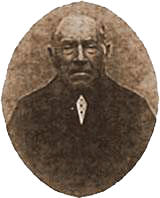 Their
only son Cornelis (1817-1885),
who was married to Hendrika de Hoop, also became a water miller on the same mill.
Their
only son Cornelis (1817-1885),
who was married to Hendrika de Hoop, also became a water miller on the same mill.
Recently
we discovered that this very same mill, they lived and worked on, still does exist.
The reason
we looked for this mill was the Historical
Reading of the life of Cornelis and Adriana, which we published earlier.
This Cornelis (1851-1925) was
a son of the Cornelis mentioned before. The Historical Reading starts with a
fairly detailed description of where the mill of the Versteegt family was
located.
There are quite a few pieces of information
found in
the family-archives of Henk Versteegt concerning the mill during this
period of time. We found some letters of Johannes from 1855 he had written to the polder
board to ask if it was possible for him to retire and also if it was possible to
assign his son Cornelis to this post.
On the old maps of 1771, we can see the mill
mentioned as "2e Loopicker Molen" (second mill of Lopik).
It is pointed out by the little blue arrows on the map below. So, we know exactly
where the mills were located.

Today the family mill is known as the
middle or 2nd mill of Cabauw.
Cabauw is a small town east of Schoonhoven and is part of the town of Lopik. We
can find on the internet a lot of information about the mill, such as
this page in the Dutch Mill database.
From the
archives of the district water board of Lopik we know that the millers mentioned
below have worked and lived on this mill:
J. Versteegt,
from 1811 to 1855.
C. Versteegt, from 1855 to 1884.
W. Rietveld 1884
J. de Lange 1915-1959
M. Noorlander, 1951-1962
F.A. Noorlander, 1951-1970
E.Stoop,
present
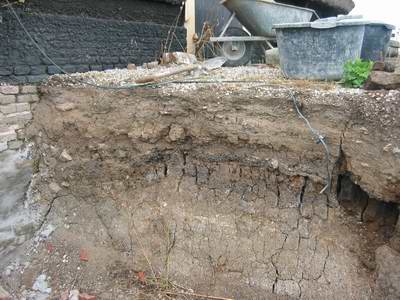
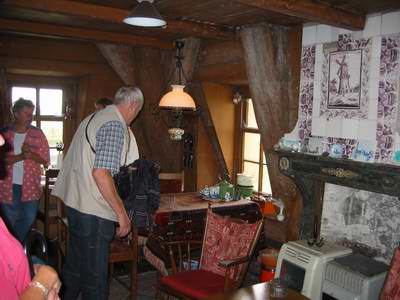
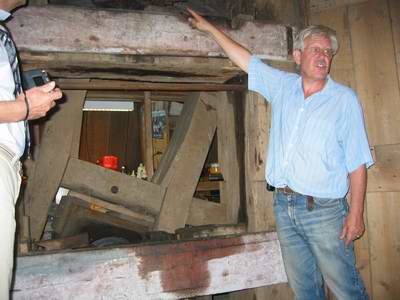
Of course we went over there to see what this
very special mill looks like. Below we see a photo-report of this visit:
 |
The address of the mill:
Lopikerweg west 106 in Cabauw (east of Schoonhoven). Watch carefully
for a mill sign, by the road, that directs you to the red and white
mill sign, that we see in this photograph. This sign is
not visable from the road. Far away we can already see the mill, a
walk of about 2 kilometers, but first let's have a look at the
board. |
| Some parts of the mill, on the board,
can be enlarged by clicking on them. |
 |
And then of course we move on to the mill. By clicking the
"Closer"-button we can see the mill closer and closer.
In the end, we can conclude, that with this mill there is a
nice part of our family history still visible for us.

As we all know
this 2nd Lopicker Mill was one of a series of 3 close mills. The
ruins of the 3td mill can be found along a route you can follow. This route
is known as the "Cabauwse Jacobsroute". More information about the route can
be obtained from the café "Het Witte Paard" (The white Horse) in Lopik. Tel
0348-551532.
There is also a brochure
available about our family mill. The two pages of the brochure maybe
downloaded by clicking on the page numbers listed below. Please note that
the two pages are not translated into English, but it is still interesting
to look at the brochure in the Dutch language.
Page 1
Page 2
The Foundation "Friends of the
Cabauwse Mill" supports the preservation of the mill with advise and action.
You can become a friend of the mill by making a donation of at least 6
Euro a year by check payable to the foundation(see the
form on the brochure)
and completing the information form and mailing the form to the address on
the brochure. At this time it is not known if our American ancestors may
join the foundation. For more information on joining the foundation, please
take a look on the website of the Mill.
 |
In 2005 a book about the mill was
published by Rob Alkemade and Erik Stoop, the miller. In 80 pages the
history of the mill and the millers is described. From page 40 until
page 53 the period where our ancestors Johannes and Cornelis Versteegt
were millers on this mill is described. It is very interesting to read
what they have gone through and what they were occupied with. See the 2
sample pages. The book
itself is obtainable on
the site of the mill. Click on "Geschiedenis" in the menu and you'll
see all the information you need (in Dutch unfortunately, but it's
intended to translate this site into English as well).
|
Last edited on
20-08-06