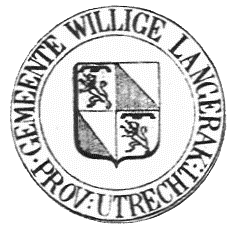
Willige Langerak.
This page is translated by Vincent Ver Steegt from Dutch into English in April 2005.
For the family Versteegt/Ver Steegt this small village close to Schoonhoven is one of the places where there is a great deal of Versteegt/Ver Steegt family history. For all of our American family relatives their roots lie in this village as Willige Langerack is where the American family relatives came from. Cornelis and Henrika may have lived here by 1885. Their son Cornelis and his wife Adriane’s 15 children were born here and from here 3 left for America. See the American Connection
Willige Langerack, the small town, merged with the municipality Lopik on 1 January 1943. The old village center of Willige Langerak was merged with the municipality of Schoonhoven in 1970. The result of this is that the church of Willige Langerack is now in Schoonoven. By studying the maps of the region we see where Willige Langerak is.
What is origin of the name? The name written down in 1396 was Wilghen. In 1639 the name mention was Willige Langerack. The 1st part of the name means "the place near the willow trees. The 2nd part of the name means “a long straight part of the river. (the river Lek in this instance)". In 1632 the population of the village was 283, in 1811 there were 329 inhabitants. There was almost no change in population in almost 200 years.
Kees Versteegt (1851-1925) lived in Willige Langerak, after he came back from America, (see the
story about Kees and his wife Adriana) where the streets “Tiendweg” and “Graaf Floris IV weg” meet. We see in the photo, taken in approximately 1929, in the distance, on the right side of the photo, the house where they lived.

The house facing the opposite direction,
in the back of the photo behind the trees, is also a house he built. In this house, at the present time, there is the Nature Museum where his greatgrand child Lou Rijneveld and his wife Marijke live.

For more information on the Nature Museum you can click
here.
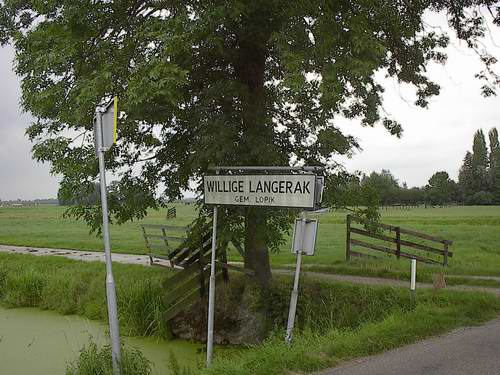
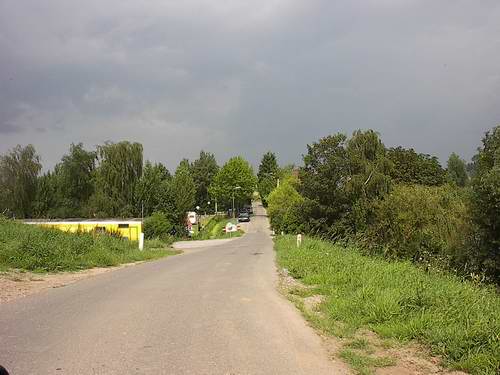
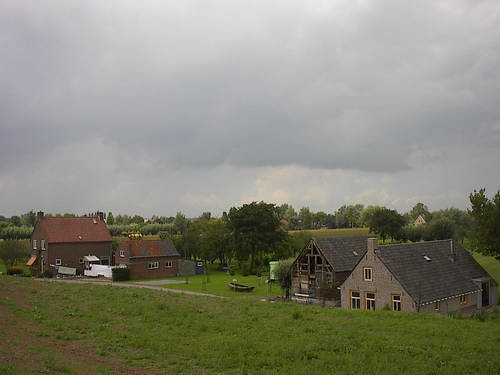
The next few photo’s of the Willige Langerak neighborhood give us an impression what the beautiful land surrounding the village, where our forefathers lived in so long ago, looks like.
 |
 |
 |
Last edited on 19-03-06